

Table of Contents
Most traders lose money. That’s not opinion — that’s data. Studies consistently show that over 80% of retail traders lose, and the ones who consistently profit share one habit in common: they use a trading journal to track, measure, and improve their decisions.
I learned this the hard way, so you don’t have to. Here’s why every trader needs a trading journal — and what happened when I finally started using one properly.
The Trade That Made Me Start a Trading Journal
I still remember the trade clearly. EUR/USD had just broken a key resistance level after a weaker-than-expected German ZEW economic sentiment report. I had done my research. I knew the data was coming. Everything lined up.
I entered long. The trade worked perfectly. I made a solid profit.
Then I tried the exact same approach the next week. And lost.
Not because the setup was bad. Not because the fundamentals were wrong. But because I had no idea what I had actually done right the first time. I couldn’t replicate my own success. I didn’t know which variable made the difference — was it the pair, the session, the event type, or just luck?
That’s when it hit me: I was gambling, not trading. I was making decisions based on gut feel and memory — and memory is the most unreliable tool a trader has. I needed a real trading journal, something built for the way trading actually works, not a spreadsheet or a notepad.
So I built one. Here’s why it changed everything.
What a Good Trading Journal Actually Tracks
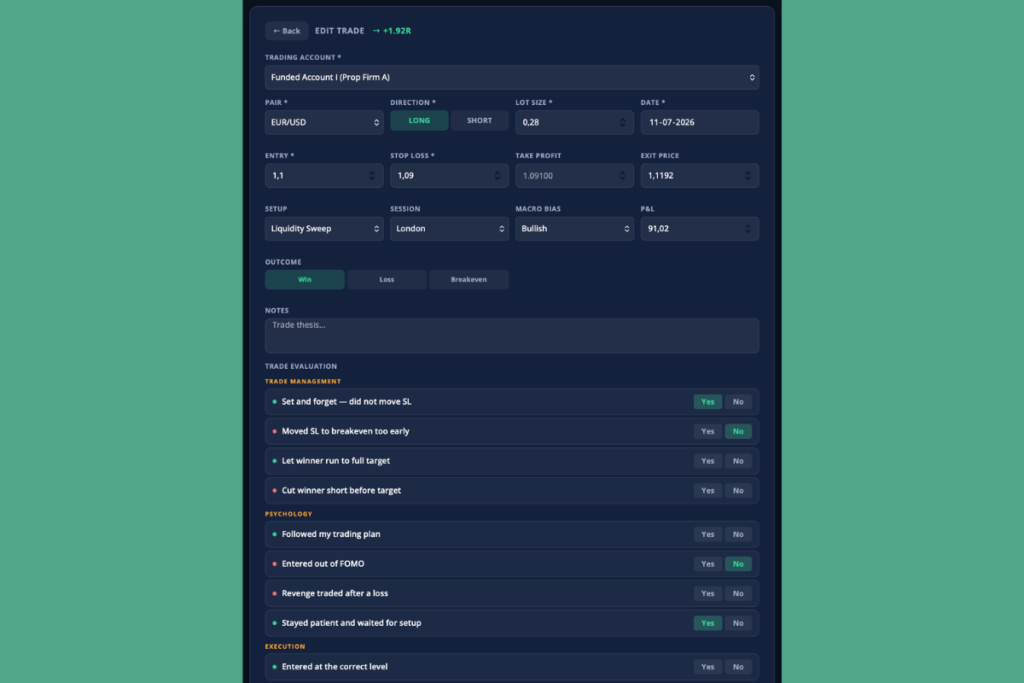
A real trading journal goes far beyond entry and exit prices. The best ones capture five key areas:
- The setup and rationale — what conditions triggered the trade and why you believed it would work
- The context — market conditions, event drivers, session, and instrument
- Psychology before entry — your confidence level, emotional state, and whether you followed your plan
- Execution details — entry, exit, stop loss, R:R ratio, screenshots
- Post-trade review — what went well, what went wrong, what to do differently
When you track these things consistently across every trade, patterns emerge that no indicator, no course, and no signal service can show you. You stop guessing and start knowing.
Why Most Traders Don’t Use a Trading Journal
Let’s be honest: journaling is boring. After a long day of watching charts, analyzing data, and managing emotions, the last thing you want to do is fill out another form. I get it.
But here’s the hard truth — if you’re not using a trading journal, you’re not seriously trading. You’re hoping. And hope is not a strategy.
Most traders who skip journaling fall into the same four traps:
- They remember winners and forget losers — confirmation bias makes you think you’re better than you actually are
- They repeat the same mistakes — because they never documented what the mistake was in the first place
- They can’t scale — without data, you can’t identify which setups truly give you an edge and which ones are just noise
They blame the market — when the real issue is their own execution, discipline, or strategy
A trading journal eliminates all four problems. It turns vague feelings into hard data.
What I Learned After 100 Journaled Trades
After my first 100 trades in the journal, the data told me things I didn’t want to hear but desperately needed to know:
- I only have a real edge on two instruments — everything else was noise eating my P&L
- I break my own rules most often immediately after a big win — overconfidence is expensive
- My best trading days are Wednesday and Thursday — Monday and Friday, I force setups that aren’t there
- Major central bank decisions produce my highest-probability setups, not routine news releases
Without a trading journal, I would have kept trading instruments I have no edge on, forcing setups on bad days, and sabotaging myself after wins. I would have blamed the market instead of fixing my own process.
What the Fortis Trade Journal Does Differently
After trying Edgewonk, Tradervue, and Tradersync, I realized most journals are either overcomplicated, too generic, or expensive — charging $15-$30 per month. So I built my own: the Fortis Trade Journal, a free trading journal designed for the way traders actually work.
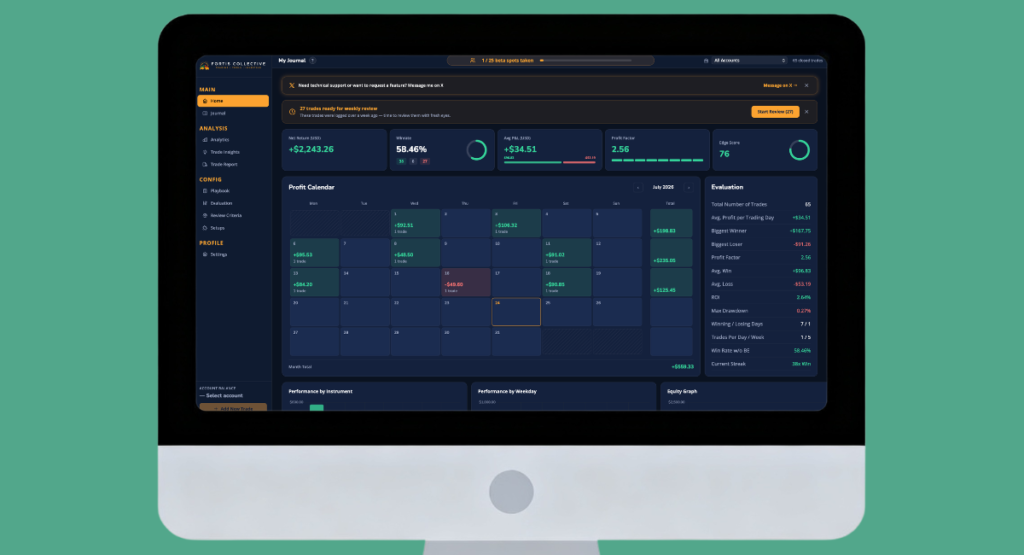
Edge Score. One number distilled from your actual trading data, alongside win rate, profit factor, and a clickable Profit Calendar that shows performance day by day.
Override Scorecard. Tracks exactly how much ignoring your own pre-trade warnings has cost you over time. That number hurts. That’s the point.
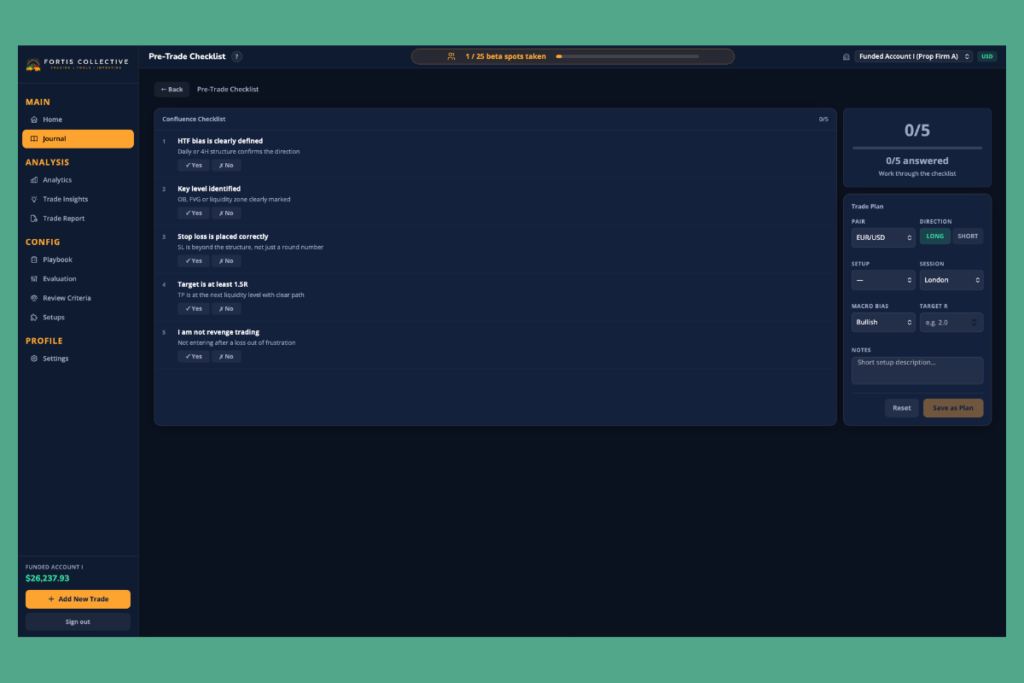
Pre-Trade Checklist. You define your confluence rules, and the journal warns you in real time based on your own trading history. It’s designed to stop you from repeating mistakes before you make them.
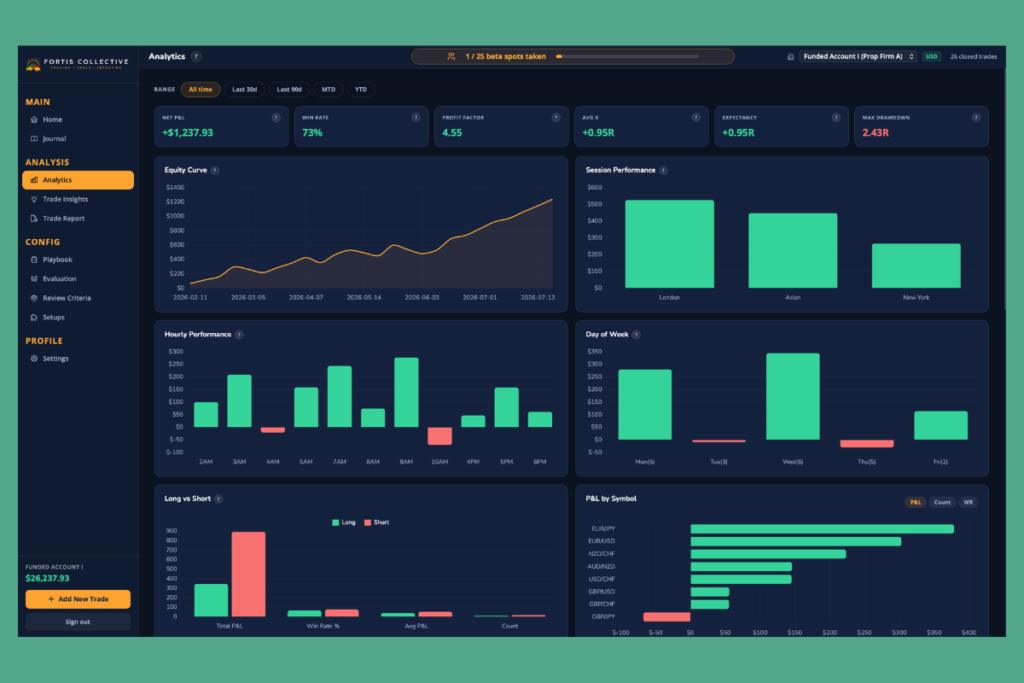
Analytics. Performance breakdowns by instrument, weekday, hour, session, and R-multiple distribution. The kind of analysis that turns vague feelings into concrete answers.
Multi-account support. Track multiple accounts with separate balances, currencies, deposits, and withdrawals — all in one place.
The Fortis Trade Journal is currently free in open beta with limited spots available, because I believe serious traders shouldn’t have to pay for the tool that helps them find their edge.
How to Start Using a Trading Journal Today
You don’t need a complex system. You just need to start:
- Journal your next trade. Capture the setup, the rationale, and the outcome. Even pen and paper works for trade number one.
- Commit to at least 10 trades. You won’t see meaningful patterns in 2-3 trades. Give the data time to speak.
- Review after every 10 trades. Look for what’s working, what isn’t, and where you broke your own rules. Adjust accordingly.
The difference between a hobbyist trader and a professional is simple: professionals track, measure, and improve. Hobbyists just hope.
If you want to fast-track the process, use a proper trading journal from day one. The Fortis Trade Journal is free, built by a funded trader, and designed to show you exactly where your edge is — and where it isn’t.
Your trading data is your competitive advantage. Start treating it that way.
Derek FX — Funded Forex Trader. Try the free trading journal at journal.fortis-collective.com.
Further reading: Why you need a trading journal — Investopedia | Why every trader needs a trading journal — Foxtraders